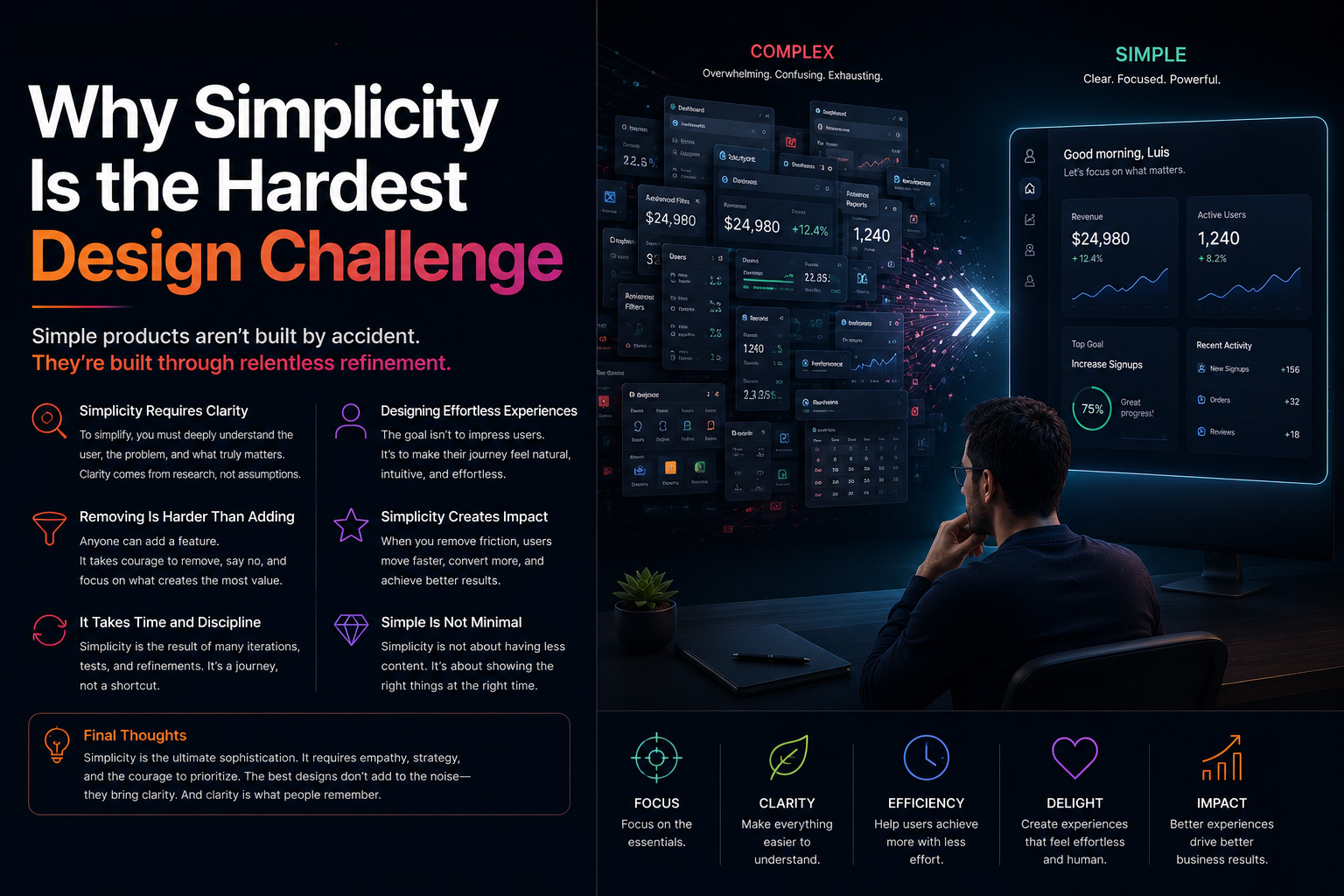
Simple products aren’t built by accident. They’re built through relentless refinement.
In digital product design, adding something is easy.
A new feature.
Another button.
Another menu.
Another setting.
Another notification.
Removing something is much harder.
That’s because simplicity requires understanding what truly matters and having the discipline to remove everything else.
Simplicity isn’t the absence of complexity. It’s the result of resolving it.
The Illusion of Simple
Some of the world’s most successful digital products look incredibly simple.
A clean interface.
A few meaningful actions.
Very little visual noise.
But what users see is only the final result.
Behind that simplicity are hundreds of decisions about:
What to show
What to hide
What to prioritize
What to automate
What to remove
What users need at each moment
Simple experiences are often the result of complex thinking.
Simplicity Starts With Clarity
You cannot simplify something you don’t understand.
Before removing elements from an experience, designers need to understand the user, the business problem, and the context in which the product is being used.
That requires research.
It requires observation.
It requires asking difficult questions.
What does the user actually need?
What is creating friction?
What information is essential?
What can disappear without reducing value?
Clarity comes before simplicity.
Removing Is Harder Than Adding
Anyone can add another feature to a product.
Removing one requires evidence.
It may mean challenging a stakeholder.
It may mean questioning an assumption that has existed for years.
It may mean telling a team that a feature users rarely need should not be prioritized.
That’s why simplicity requires courage.
The best designers aren’t just good at creating.
They’re good at saying no.
Simplicity Requires Discipline
A product doesn’t become simple after one redesign.
It becomes simple through continuous refinement.
Research.
Testing.
Iteration.
Measurement.
Removal.
Repeat.
Every release is an opportunity to ask:
Can this experience be easier?
The answer isn’t always yes.
But asking the question consistently creates better products.
Simple Doesn’t Mean Minimal
There’s an important distinction between simplicity and minimalism.
Minimalism focuses on reducing visual elements.
Simplicity focuses on reducing cognitive effort.
A simple product can still be powerful.
It can contain sophisticated technology, complex data, and advanced capabilities.
The difference is that the complexity stays behind the scenes whenever possible.
Users shouldn’t have to understand how the system works.
They should simply be able to accomplish what they came to do.
AI Makes Simplicity Even More Important
Artificial Intelligence is changing what interfaces can do.
Instead of forcing users to navigate through complex workflows, AI can interpret intent and handle multiple steps behind the scenes.
This creates a new design opportunity.
Instead of exposing every capability, products can expose the outcome.
The interface becomes less about navigation and more about conversation, context, and intelligent assistance.
But this creates another challenge:
When technology becomes more complex, the experience must become even clearer.
The Business Impact of Simplicity
Simplicity isn’t just a design preference.
It can directly influence business performance.
Reducing friction can lead to:
Faster task completion
Higher conversion
Better adoption
Lower support costs
Improved customer satisfaction
Stronger retention
When customers can accomplish what they need with less effort, everyone benefits.
Final Thoughts
The best digital products don’t necessarily have fewer capabilities.
They make those capabilities easier to understand and use.
That’s the real challenge.
Simple is not easy.
Simple is the result of deep understanding, difficult decisions, continuous testing, and relentless refinement.
Great designers don’t add more to make products valuable.
They remove everything that gets in the way of value.
Clear thinking creates simpler experiences.
Simpler experiences create better outcomes.