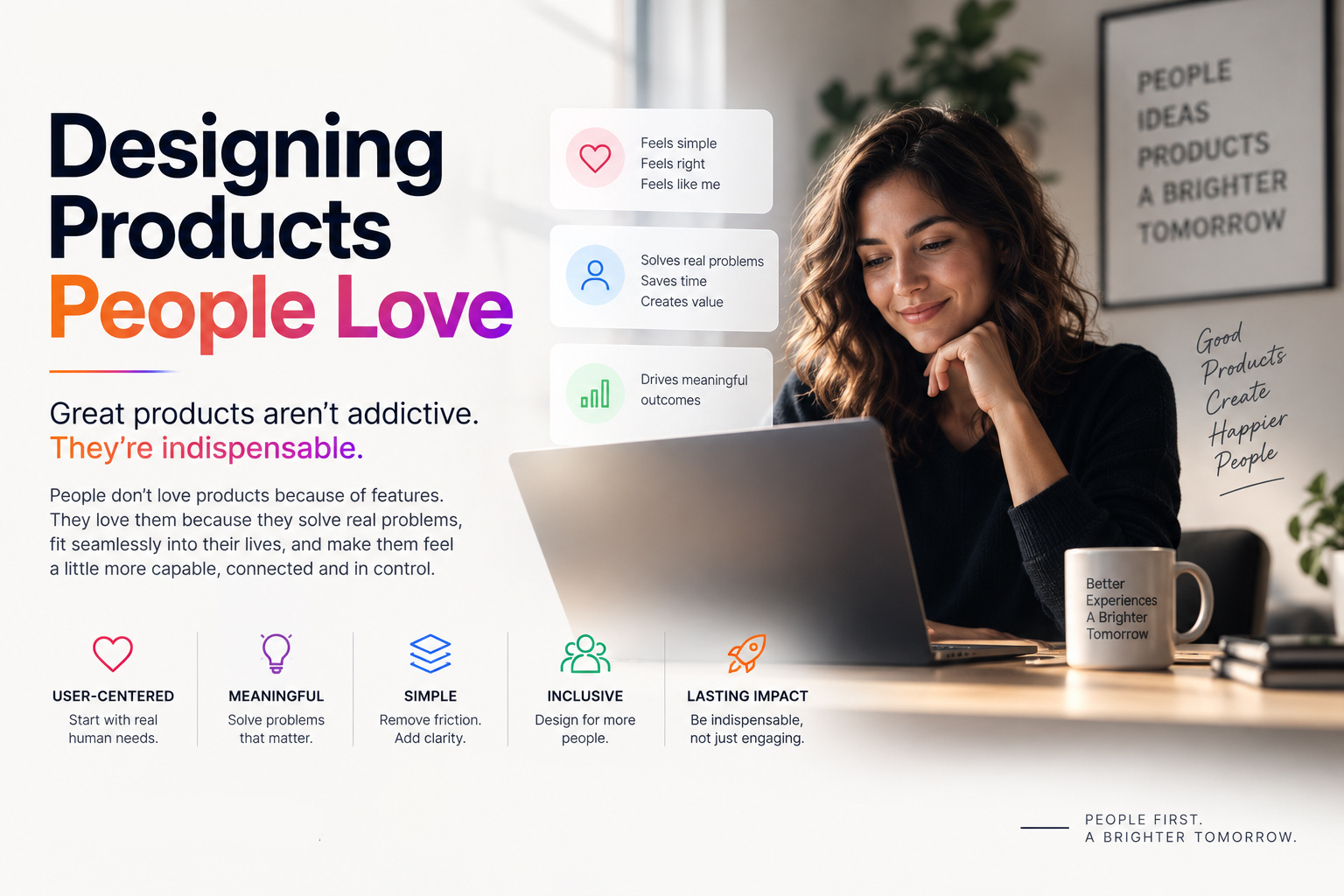
Great products aren’t addictive. They’re indispensable.
Why do people keep coming back to certain digital products?
Why do some apps become part of our daily routines while others are quickly forgotten?
The answer isn’t always a longer feature list, a more attractive interface, or a clever marketing campaign.
People love products that consistently make their lives better.
Products that save time, reduce frustration, help people achieve their goals, and create experiences they can rely on.
In a competitive digital landscape, building something people can use is no longer enough.
The real opportunity is to create something people genuinely value.
Start With a Meaningful Problem
Products people love usually begin with a clear understanding of a problem worth solving.
Before thinking about features, interfaces, or technology, Product Designers need to understand what people are trying to accomplish.
What frustrates them?
What takes too much time?
What feels unnecessarily complicated?
What are they struggling to achieve with the solutions available today?
A product becomes valuable when it addresses a real need in a meaningful way.
The more clearly a team understands that need, the better equipped it is to design an experience that makes a difference.
Great products don’t create artificial needs. They solve meaningful problems.
Make the Experience Effortless
People don’t want to work harder than necessary to accomplish a task.
They want to find what they need, understand what to do, and achieve their goals without unnecessary friction.
That requires thoughtful decisions about:
Navigation and information architecture
Clear and understandable interactions
Cognitive load and decision-making
Accessibility and inclusive design
Feedback and error recovery
Performance and responsiveness
Every unnecessary step creates an opportunity for frustration.
Every confusing interaction creates uncertainty.
Every improvement that makes a task easier can strengthen the relationship between the user and the product.
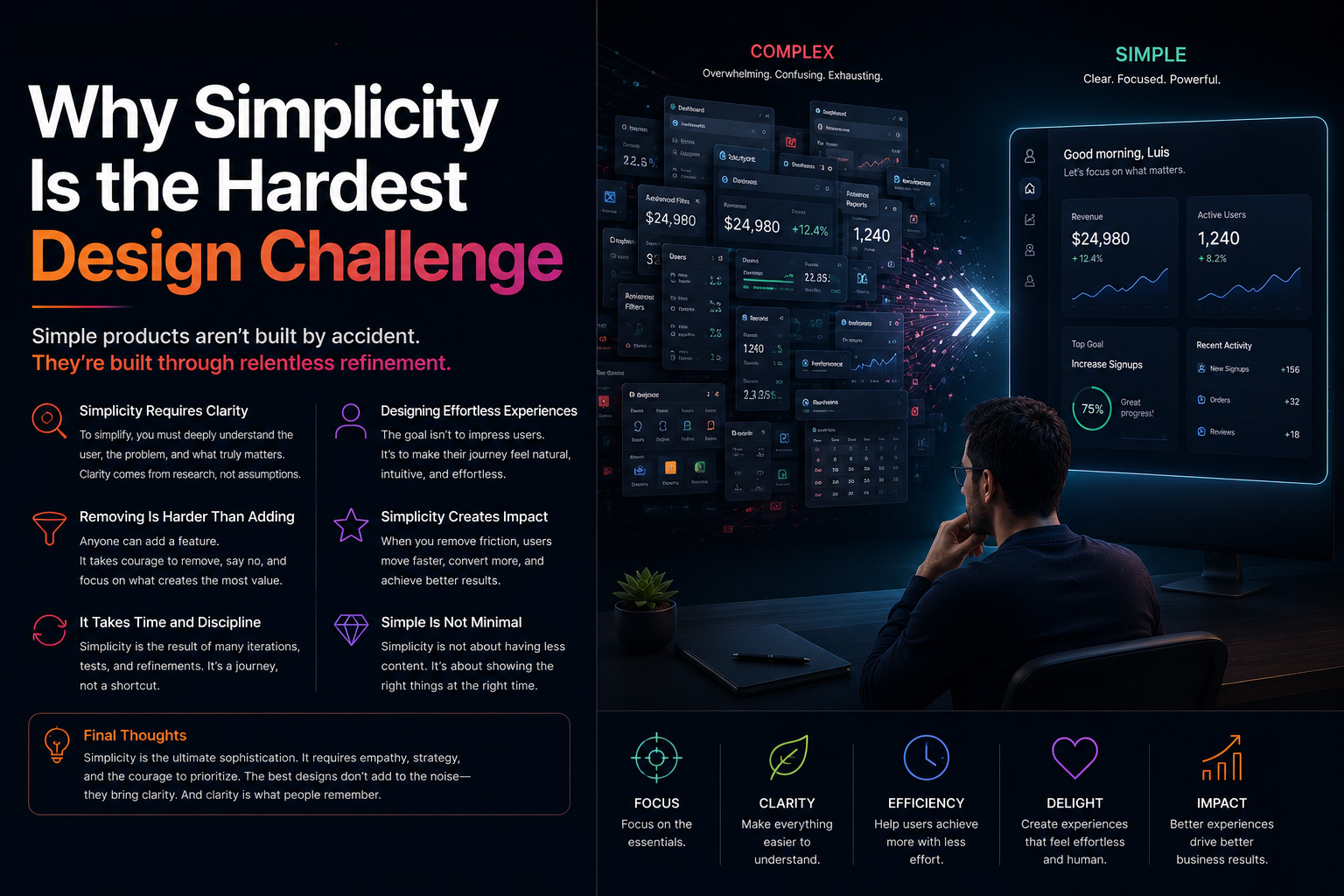
Simplicity isn’t about removing everything.
It’s about making the important things easier.
Build Trust Through Consistency
A great experience isn’t defined by a single impressive interaction.
It’s built over time.
Users need to know what to expect when they return to a product.
They need interfaces that behave consistently, information they can understand, and systems that work reliably.
When something goes wrong, they need clear communication and a way forward.
Trust grows when a product repeatedly delivers on its promises.
That means reliability, transparency, privacy, and predictable behavior aren’t secondary considerations.
They’re essential parts of the experience.
A product earns trust through what it does not just what it says.
Design for Emotional Connection
People don’t interact with digital products in a purely rational way.
They experience frustration, relief, confidence, curiosity, and satisfaction.
These emotions influence how they perceive an experience.
A thoughtful onboarding process can make someone feel confident.
A clear confirmation can provide reassurance.
A well-designed interaction can make a complicated task feel manageable.
A helpful error message can turn a frustrating moment into a recoverable one.
Emotional design doesn’t require excessive animations or decorative elements.
Often, the most meaningful moments are surprisingly simple.
The product understands what the user needs, responds appropriately, and makes the next step clear.
Help Users Achieve Their Goals
A product should be evaluated by more than how long people spend using it.
Engagement can be useful, but it isn’t automatically evidence of value.
A banking app that helps someone complete a payment in seconds may be delivering a better experience than one that keeps them navigating through multiple screens.
A productivity tool that reduces unnecessary work may be more valuable than one that encourages constant interaction.
A customer support platform that resolves an issue quickly may create more satisfaction than one that generates repeated visits.
The objective isn’t to maximize interaction. It’s to maximize meaningful value.
Designers should consider whether users are accomplishing what they came to do and whether the product is helping them do it effectively.
Create Value That Grows Over Time
The relationship between a user and a product evolves.
As people become more familiar with a product, they may discover new capabilities, develop useful habits, and incorporate it into their workflows.
But that relationship needs to be earned.
Products can strengthen long-term value by:
Delivering reliable results
Adapting to changing user needs
Making relevant improvements
Providing useful personalization
Supporting users as their goals evolve
Listening and responding to feedback
Personalization, in particular, should make an experience more relevant without making users feel manipulated or monitored.
The goal is to help people accomplish more not to create unnecessary dependency.
Measure What Actually Matters
If a company wants to build products people love, it needs to understand what that means in practice.
Useful measures may include:
Task success: Can users accomplish what they came to do?
Customer satisfaction: How do users evaluate their experience?
Retention: Do people continue using the product because it provides ongoing value?
Customer effort: How difficult is it for users to complete important tasks?
Support requests: Are recurring problems creating unnecessary frustration?
Product outcomes: Is the experience helping users achieve meaningful results?
No single metric tells the whole story.
Quantitative data should be combined with qualitative research to understand not only what users do, but why they do it.
The objective is to measure value not simply activity.
The Role of Product Designers
Creating products people love requires more than strong visual design.
Product Designers need to connect several dimensions:
Human needs and behavior
Usability and accessibility
Product strategy and business objectives
Technology and implementation constraints
Research, experimentation, and validation
Trust, ethics, and long-term value
This means looking beyond individual screens and considering the entire experience.
From the first interaction to ongoing use, every decision can influence how people perceive a product.
Designers help teams understand those moments, identify opportunities, and create experiences that are useful, understandable, and dependable.
Final Thoughts
Products people love aren’t necessarily the ones with the most features, the most notifications, or the most sophisticated technology.
They’re the ones that consistently deliver meaningful value.
They respect people’s time.
They reduce unnecessary complexity.
They build trust.
They help users achieve their goals.
And they improve as people’s needs evolve.
As Product Designers, our responsibility isn’t to make people spend more time with a product simply for the sake of engagement.
It’s to make the time they spend with it worthwhile.
Great products don’t need to demand attention. They earn it.
Because the most meaningful relationship between a person and a digital product isn’t dependency.
It’s trust, usefulness, and lasting value.